
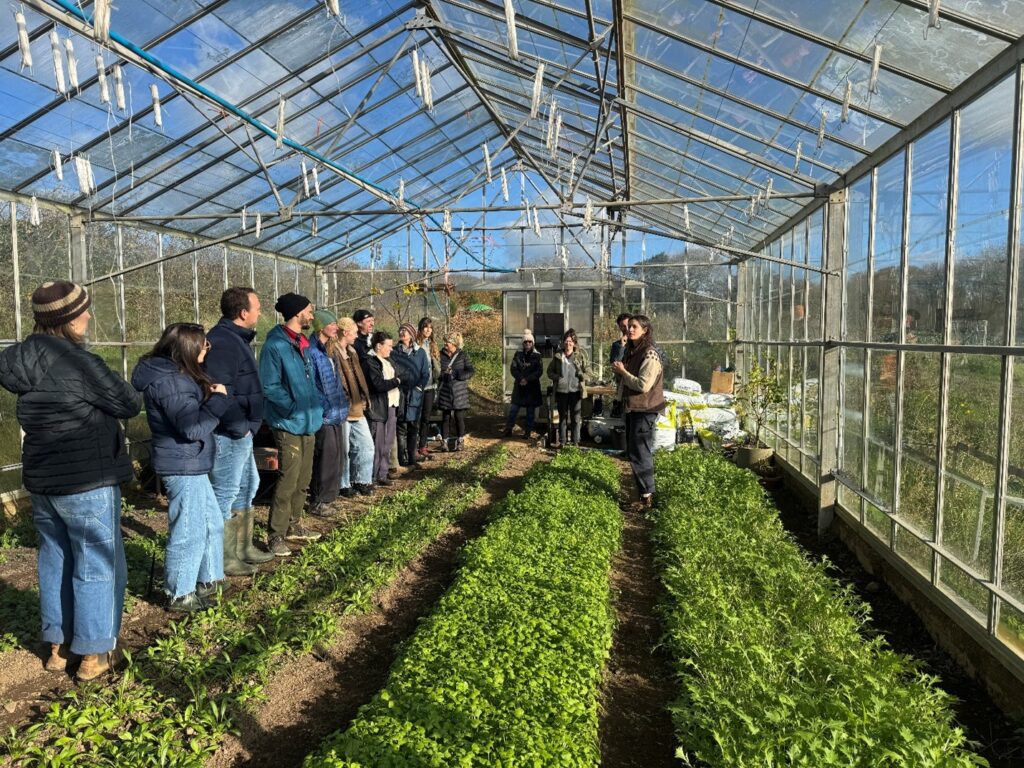
What a beautiful day to come together for one in our series of peer-to-peer learning sessions at Aral Farm as part of our Joining the Dots Programme. Aral Farm is a new CSA (Community Supported Agriculture) project in the heart of Cornwall, nestled under the shadow of Castle and Dinas. We had a fantastic turnout of 21 people, all eager to learn from Conor and Rose’s first year trading as Aral Farm.
Although this is their first year of trading, it has been a long-time dream for these young trailblazers. They bought the plot for £50,000 a few years ago, using every penny they could gather. The farm sits on a 1.8-acre south-facing slope, with the River Lhyner running along the bottom of the field. Surrounded by intensive brassica farming, Aral Farm is an oasis of crop biodiversity. They grow 48 different crops each year using bio-intensive methods (closely spaced planting) to maximize space and suppress weeds. Through permaculture design, they’ve planted numerous fruit and nut trees with an understory of fruit bushes, installed a pond and swales, introduced beehives, and keep a small flock of Muscovy ducks. There’s a lot packed into this small site!
We began the walk-and-talk in the crop wash and organizational hub of the business, where they shared how they plan and organize their weeks and year. They demonstrated efficient use of space, tools, and energy. The farm is completely off-grid, and one of their biggest investments so far has been the solar power system.
Next, we toured the plot, starting at the top with the irrigation and natural pond, looking at the compost area, pond, perennial beds, and irrigation system. Water is drawn from the pond, and they have permission to draw from the river below. Swales are arranged at points down the south-facing slope, collecting water and slowing its flow through the beds as it travels back to the river.
Then we moved down to the productive beds where Conor and Rose use bio-intensive planting to make the most of the space. Conor gave a demonstration of using the two-wheeled tractor to flail finished crops and weeds. They use a small set of tools for maximum efficiency across the farm—everything perfectly suited to the scale of their plot and geared for ease of use. Conor and Rose have benefited from the Farm Spreadsheets Course and the Jean-Martin Fortier Masterclass to set up their crop planning and rotations. They know the value of each bed and crop by the meter, which really helps them decide which crops to continue growing for profit and which to drop if they don’t cover costs.
Next, we looked at the covered cropping areas consisting of a greenhouse and two polytunnels. It’s interesting to see a glasshouse as part of new entrant infrastructure, but the investment seems to be paying off. They have a fantastic space where the environment can be controlled much more effectively than in a polytunnel. This year, they produced a mammoth amount of tomatoes, which are a very profitable crop. The tunnels were sourced second-hand for £500, which is extremely cost-effective—they’ve already paid for themselves after just one season.
Finally, we discussed governance models — Cooperative, CIC, CSA versus restaurant supply — as well as loans, grants, funding, planning, housing, and future ambitions. This was a very interesting discussion for the group, which included many new entrants. These could easily become peer-to-peer workshops in themselves and will definitely go down as topics for future events.
Sustainable Food Cornwall and FiPL are extremely grateful to Conor and Rose for giving their time to share knowledge with peers at this very valuable New Entrant Event.