
If we’re celebrating Cornish food, we need to look beyond provenance and ask how that food is actually grown.
Summer has arrived in Cornwall, and with them have “Cornish strawberries”. Displayed on signs, in farm shops and across Instagram. They’re a celebration in their own right, but as we’re celebrating local food, we mustn’t lose touch with how that food is actually grown. But did you know most Cornish strawberries aren’t even grown in Cornish soil?
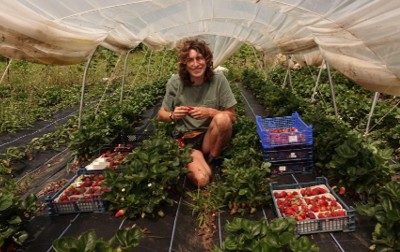
Lead Grower Rachel without any robots to help harvest in Penryn, Cornwall
“Nowadays less than 5% of strawberries continue to be grown directly in living soil”
The hidden inputs behind “Local” Strawberries
Across the UK, nearly all strawberries grow raised up in plastic gutters in fertiliser-enriched water, or in bags of imported peat. Pollinated by imported bumblebees, and grown from plants propagated in another county. The soil, the fertiliser, the insects, even the plants themselves often come from elsewhere. All as part of an efficient system in one sense of the word – but also a highly extractive, carbon intensive system that is far removed from Cornwall and reliant on global industrial supply chains we know aren’t as resilient as was once thought.
This isn’t about blaming other farmers. We’re all working within a broken food system shaped by supermarket pressures and extremely tight margins. But as consumers we need to question what phrases like “Locally-grown” or “Cornish” really tell us.
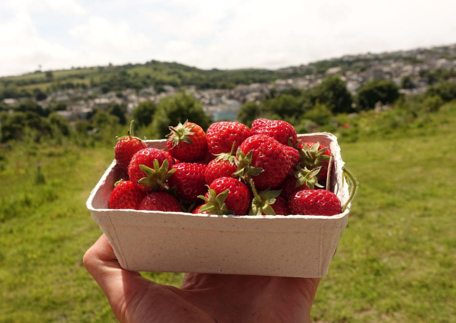
Penryn-grown strawberries grown in Penryn’s soil
Because hidden behind the pretty labels and the Cornish flags can be production methods that have very little care for the land that we call home nor it’s future.
Different ways of farming
Alternatives do exist. Organic produce must be grown in the soil. Nowadays less than 5% of strawberries continue to be grown directly in living soil. In the market garden at Loveland (Falmouth Food Coop’s community field), we’re growing strawberries as part of this minority (in amongst 40 other crops we grow). No Irish peat, no plastic gutters. Grown in Cornish soil which we care for with compost and green manures instead of artificial fertilisers. We grow our plants from our own runners, and we don’t import pollinators and natural predators because these exist in abundance naturally within the healthy, diverse farm ecosystem we have created. I reckon they taste better for it too.
Why Organic Matters
At Loveland, we’re certified Organic, which is important. It’s not just a label, it’s a certification scheme that holds us accountable to nature-friendly farming practices through regular inspections and monitoring. It shows that as a farm we are committed to standards and practices that are built on ecological foundations such as soil health, minimising inputs and creating closed-loop systems. Organic is a gold standard for food production and a label that as a consumer can be trusted.
Surely these should be the foundations of Cornish farming systems too? The reality is that anyone can use a “Cornish” or “Locally-grown” label, regardless of how that food is grown or how connected to Cornish land it is. The reality is also that a dismal 3% of UK farmland is Organic, while many of our EU neighbours sit between 8-25%.
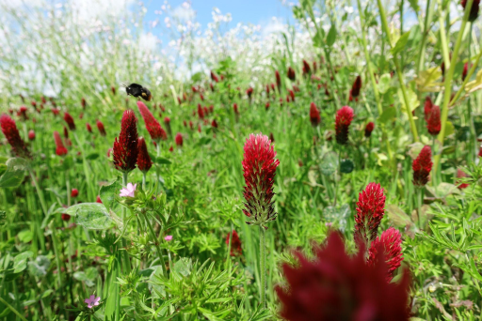
Crimson clover, a nitrogen fixing plant, flowering within a diverse green manure at Loveland. Feeding the soil and supporting biodiversity
Organic Agriculture combines tradition, innovation and science to benefit the shared environment and promote fair relationships and a good quality of life for all involved – IFOAM (Organics International)
Provenance isn’t enough
Local food matters. Of course we should keep doing our best to shop local and support our local economy . But I encourage you all to look deeper, what kind of farming do we want to celebrate? If we want food that is contributing to a rich and resilient Cornwall – rooted in the soil, ecology, and food sovereignty – then we need to support the growers who are doing that work.
Written by Finn Halsall, an Executive Director of the Falmouth Food Co-op CIC and one of the Head Growers at their market garden on Loveland which supplies produce to their online shop, local chefs, shops, farmers markets and veg box schemes.